
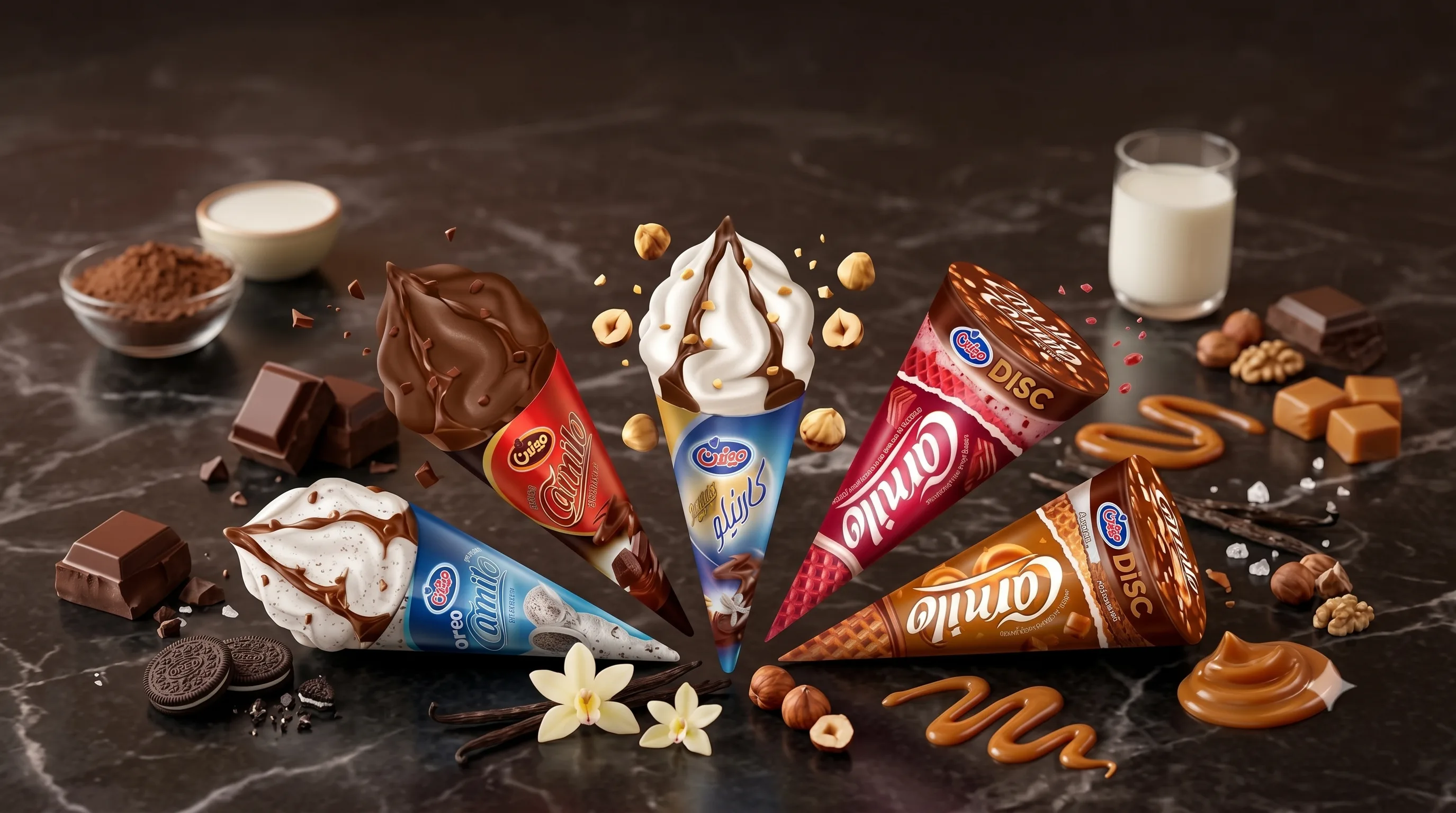
What makes quality ice cream? From fresh milk to the final freeze
How is ice cream made in a factory? What sets high-quality ice cream apart from cheaper varieties, and what role do stabilizers play?
How quality ice cream is made
The key to producing high-quality ice cream lies in the use of fresh milk, precise levels of animal fat, and the scientifically controlled implementation of processes such as homogenization, pasteurization, and aeration control.
The precise combination of these ingredients with modern rapid freezing technology results in a soft texture, rich flavor, and prevents the formation of large ice crystals in the final product.
This complex and carefully engineered process ensures that the ice cream not only has a delicious taste, but also provides high nutritional value and complete food safety.
Key points from the article
Ingredients
Using pure milk and fresh cream (with a minimum of 10% fat content) is the fundamental basis for quality.
Homogenization
This process breaks down the fat particles into a microscopic scale, creating a smooth, creamy texture.
Degree of ventilation (Overrun)
Premium and high-quality ice creams have the lowest air injection rates (between 20 and 50 percent).
Cold chain
Maintaining a temperature of -18 degrees Celsius from the production line to the consumer's freezer is the only way to preserve the product's texture.
What are the standard raw materials used in ice cream production?
Ice cream is a complex colloidal system, and its quality is directly dependent on the purity of the ingredients. The main ingredients are milk, cream, sugar, and stabilizers.
According to international food industry standards, a product must contain at least 10% pure milk fat to be legally labeled as "ice cream."
Milk solids-not-fat (MSNF), including proteins and lactose, also give the mixture body, help it hold its structure and increase its nutritional value.
The role of technology and the production process in the factory.
The key to producing high-quality ice cream lies not only in the raw materials, but also in the industrial production process, which involves precise and controlled steps carried out in advanced factories:
Pasteurization: Heating the base mixture to 85 degrees Celsius to eliminate all harmful bacteria and make the product safe.
Homogenization: The mixture is forced through microscopic openings under very high pressure to break up fat globules and keep the liquid from separating.
Aging (Maturation): Store the mixture in specialized containers at 4°C for 4 to 24 hours to allow for better fat absorption by the proteins and to optimize the performance of the stabilizer.
Initial chilling and aeration: Cooling the mixture to -5 degrees Celsius while continuously stirring and injecting air to create a soft texture and prevent hard freezing.
Hardening: Passing through tunnels with air at -40 degrees Celsius to rapidly freeze any remaining water and stabilize the final structure.
How aeration (overrun) affects ice cream quality
Overrun is one of the most important, yet often overlooked, quality indicators in the ice cream industry.
When freezing, the air is mixed into the liquid. If this step is not taken, the final product will be like a solid, non-porous ice block.
In commercially produced, inexpensive ice creams, the air content can sometimes reach 100 to 120 percent, meaning that more than half of the ice cream's volume is actually air.
However, in high-quality, premium ice creams, this ratio is typically adjusted between 20 and 50 percent to create a much denser, heavier, and more flavorful texture on the palate.
Maintaining quality and the importance of the cold chain
Producing the best and highest-quality product in the factory is only half the battle; the other half is maintaining that quality until it reaches the consumer.
Maintaining a cold chain means keeping the product's temperature at a constant -18 degrees Celsius throughout storage, transportation, and retail display.
Even small temperature fluctuations can cause thermal shock. Ice crystals partially melt and merge, noticeably damaging the texture.
Frequently Asked Questions (FAQ)
1. Why are the textures of some ice creams so stringy and soft? Natural salep or standard stabilizers, together with homogenization, help the water and fat bind more closely. The result is a soft, stretchy texture that resists rapid melting.
2. What is the difference between commercially produced ice cream and gelato? Gelato (authentic Italian ice cream) has a lower fat content (around 4-8%) and significantly less air (lower overrun) compared to commercially produced ice cream. Furthermore, gelato is served at a warmer temperature (around -12 degrees Celsius), which allows for the more pronounced release of flavors on the taste buds.
3. What is the use of stabilizers in ice cream production? These ingredients, primarily plant-based (such as guar gum, carob gum, or carrageenan), prevent the formation of large ice crystals by absorbing and trapping free water, thus maintaining the ice cream's smooth texture for an extended period.
4. Do artificial colors and flavorings reduce the quality of ice cream? Premium and high-quality ice creams on a global scale typically use natural extracts (such as real vanilla, fresh fruit puree, and pure cocoa powder). The use of completely synthetic additives is often a tactic to mask the decline in the quality of the base materials.
Sources
The International Dairy Federation (IDF): Legal standards for the composition and production of commercial ice cream.
U.S. Food and Drug Administration (FDA): Regulations regarding pasteurization, homogenization, and the safety of dairy products.
University of Guelph: Scientific research on colloidal structure, aging processes, and the impact of aeration in ice cream.
Conversation
Your comment
Share your thoughts with us and others.
Approved comments
Latest group news


What makes quality ice cream? From fresh milk to the final freeze
How is ice cream made in a factory? What sets high-quality ice cream apart from cheaper varieties, and what role do stabilizers play?
How quality ice cream is made
The key to producing high-quality ice cream lies in the use of fresh milk, precise levels of animal fat, and the scientifically controlled implementation of processes such as homogenization, pasteurization, and aeration control.
The precise combination of these ingredients with modern rapid freezing technology results in a soft texture, rich flavor, and prevents the formation of large ice crystals in the final product.
This complex and carefully engineered process ensures that the ice cream not only has a delicious taste, but also provides high nutritional value and complete food safety.
Key points from the article
Ingredients
Using pure milk and fresh cream (with a minimum of 10% fat content) is the fundamental basis for quality.
Homogenization
This process breaks down the fat particles into a microscopic scale, creating a smooth, creamy texture.
Degree of ventilation (Overrun)
Premium and high-quality ice creams have the lowest air injection rates (between 20 and 50 percent).
Cold chain
Maintaining a temperature of -18 degrees Celsius from the production line to the consumer's freezer is the only way to preserve the product's texture.
What are the standard raw materials used in ice cream production?
Ice cream is a complex colloidal system, and its quality is directly dependent on the purity of the ingredients. The main ingredients are milk, cream, sugar, and stabilizers.
According to international food industry standards, a product must contain at least 10% pure milk fat to be legally labeled as "ice cream."
Milk solids-not-fat (MSNF), including proteins and lactose, also give the mixture body, help it hold its structure and increase its nutritional value.
The role of technology and the production process in the factory.
The key to producing high-quality ice cream lies not only in the raw materials, but also in the industrial production process, which involves precise and controlled steps carried out in advanced factories:
Pasteurization: Heating the base mixture to 85 degrees Celsius to eliminate all harmful bacteria and make the product safe.
Homogenization: The mixture is forced through microscopic openings under very high pressure to break up fat globules and keep the liquid from separating.
Aging (Maturation): Store the mixture in specialized containers at 4°C for 4 to 24 hours to allow for better fat absorption by the proteins and to optimize the performance of the stabilizer.
Initial chilling and aeration: Cooling the mixture to -5 degrees Celsius while continuously stirring and injecting air to create a soft texture and prevent hard freezing.
Hardening: Passing through tunnels with air at -40 degrees Celsius to rapidly freeze any remaining water and stabilize the final structure.
How aeration (overrun) affects ice cream quality
Overrun is one of the most important, yet often overlooked, quality indicators in the ice cream industry.
When freezing, the air is mixed into the liquid. If this step is not taken, the final product will be like a solid, non-porous ice block.
In commercially produced, inexpensive ice creams, the air content can sometimes reach 100 to 120 percent, meaning that more than half of the ice cream's volume is actually air.
However, in high-quality, premium ice creams, this ratio is typically adjusted between 20 and 50 percent to create a much denser, heavier, and more flavorful texture on the palate.
Maintaining quality and the importance of the cold chain
Producing the best and highest-quality product in the factory is only half the battle; the other half is maintaining that quality until it reaches the consumer.
Maintaining a cold chain means keeping the product's temperature at a constant -18 degrees Celsius throughout storage, transportation, and retail display.
Even small temperature fluctuations can cause thermal shock. Ice crystals partially melt and merge, noticeably damaging the texture.
Frequently Asked Questions (FAQ)
1. Why are the textures of some ice creams so stringy and soft? Natural salep or standard stabilizers, together with homogenization, help the water and fat bind more closely. The result is a soft, stretchy texture that resists rapid melting.
2. What is the difference between commercially produced ice cream and gelato? Gelato (authentic Italian ice cream) has a lower fat content (around 4-8%) and significantly less air (lower overrun) compared to commercially produced ice cream. Furthermore, gelato is served at a warmer temperature (around -12 degrees Celsius), which allows for the more pronounced release of flavors on the taste buds.
3. What is the use of stabilizers in ice cream production? These ingredients, primarily plant-based (such as guar gum, carob gum, or carrageenan), prevent the formation of large ice crystals by absorbing and trapping free water, thus maintaining the ice cream's smooth texture for an extended period.
4. Do artificial colors and flavorings reduce the quality of ice cream? Premium and high-quality ice creams on a global scale typically use natural extracts (such as real vanilla, fresh fruit puree, and pure cocoa powder). The use of completely synthetic additives is often a tactic to mask the decline in the quality of the base materials.
Sources
The International Dairy Federation (IDF): Legal standards for the composition and production of commercial ice cream.
U.S. Food and Drug Administration (FDA): Regulations regarding pasteurization, homogenization, and the safety of dairy products.
University of Guelph: Scientific research on colloidal structure, aging processes, and the impact of aeration in ice cream.